
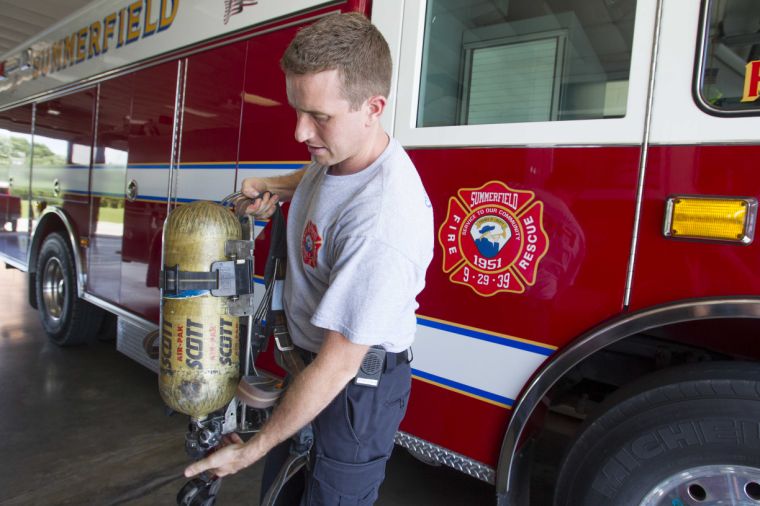
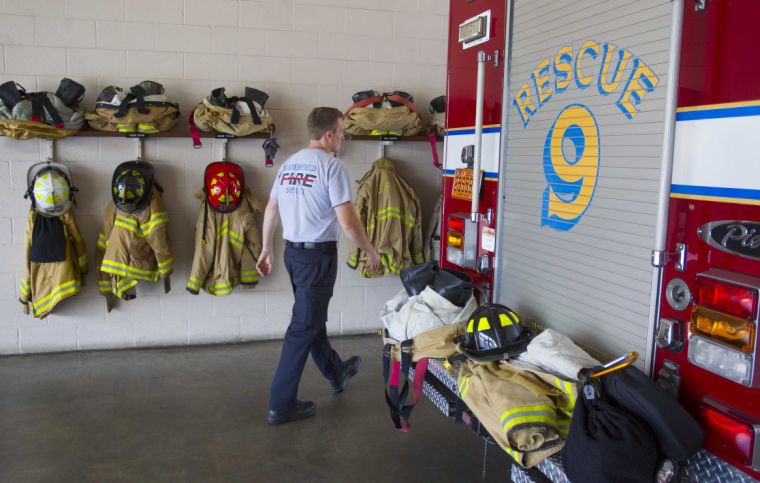
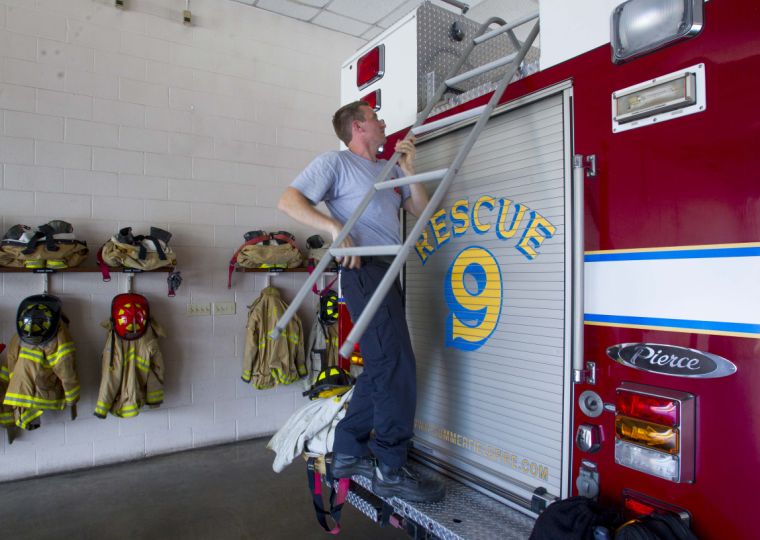
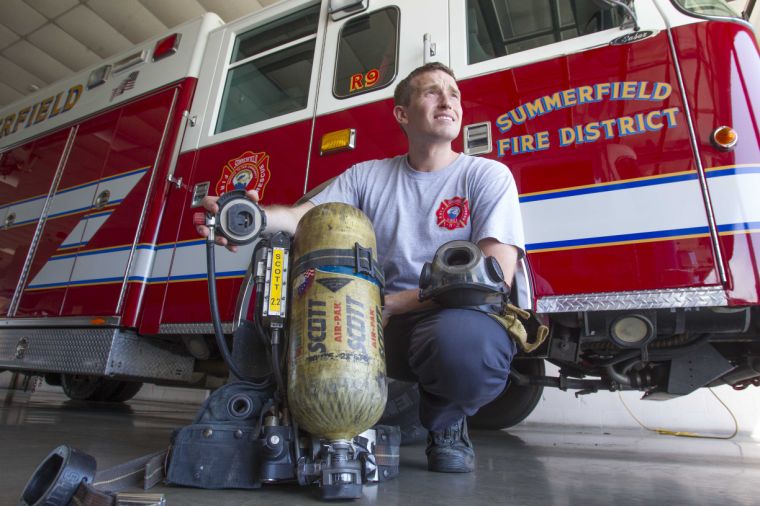
Our own Fire Chief recently took part in an article by the News & Record on the continuing shortage of volunteer firefighters not only here in Guilford County, but nation wide. If you’ve ever had a desire for public service, feel free to call Station 47 Monday thru Friday between 8am-5pm to find out more information!
Rural fire districts running short on volunteers
Posted: Saturday, June 15, 2013 12:00 am | Updated: 11:39 am, Sat Jun 15, 2013.
 GREENSBORO — On Tuesday, the Summerfield Fire Department received three emergency calls at once — a fire alarm, an outdoor fire and someone having chest pains.
The alert went out for volunteers — the backbone of most small town fire departments.
Out of 42 volunteer firefighters, only one went out on the calls.
“That happens more and more,” said Summerfield Fire Chief Chris Johnson.
The Summerfield department has just seven full-time fire professionals, with a few part-timers filling in, running three fire stations.
“We rely very heavily on our volunteers,” Johnson said. “But there just aren’t as many of them as there used to be, and the ones we have — they’re not always available.”
It’s a common story in Guilford County, which instead of a county-wide fire department has 19 fire districts covering areas outside the major cities, Greensboro and High Point, which have their own departments.
This year, nine of those districts are requesting district tax increases — mostly to deal with higher call volume and fewer firefighters to handle calls.
The increases will help replace old equipment and allow the departments to hire more full- and part-time professional fire staff.
The dwindling number of volunteers tells the story of a changing economy and a shifting culture in small towns, area fire chiefs say.
“When a lot of these departments were started, they were made up by farmers,” said McLeansville Fire Chief Roy Rimmer. “If there was a fire, they could all stop and respond to it.
“Nowadays, you’ve got people working two jobs — and they usually live here and work in a bigger city.”
That was the case even during the 23 years Rimmer spent as a volunteer firefighter. He lived in McLeansville and worked at Cone Mills in Greensboro. Back then, though, his employer and many others would let volunteer firefighters leave work to handle emergency calls when needed.
That’s not something you see much anymore, Rimmer said.
“I’ve got 42 volunteers on the roster,” Johnson said of his Summerfield department. “That’s not as many as we’ve seen in the past, but they’re a good group. But not all of them are really in a position, between work and family obligations, to respond to every call.”
Rimmer said McLeansville has 33 volunteer firefighters on their roster, but only 10 who he’d describe as very active. That’s down from about 50 volunteers, which used to be the average.
“There are departments who used to have to turn away volunteers, or put them on a waiting list,” Rimmer said. “That’s not happening anymore.”
These days there are also more and different kinds of calls.
“About 80 percent of our calls are medical,” said Rimmer. “In a rural area like we’re in, you call the fire department when there’s a problem. If someone’s hurt, if there’s a storm and there are trees down in the road, we take that call.”
With a base in their communities, rural fire departments can often respond to nearby emergencies faster than Guilford County Emergency Medical Services and often assist on ambulance and police calls.
The sort of training that’s required to provide that level of service can be daunting to new volunteers.
Many departments prefer volunteers who have Emergency Medical Technician training — about 170 hours’ worth. But even basic firefighting certification takes longer than it once did.
“What we require now for state certification takes a year to a year and a half of classes,” Rimmer said. “When I came in, there were nine or 10 classes and it took about six months.”
Guilford County Commissioner Alan Branson said the commitment volunteers show to both training and the service to their community is impressive and the rural fire districts are worth preserving.
Branson, a Republican, said he isn’t wild about the idea of raising fire district tax rates. But he’s going to encourage the commissioners to support the nine district chiefs’ request.
“These are the people in the community who answer the call when there’s an emergency,” Branson said. “We have to give them what they need to do that job.”
News & Record: Rural fire districts running short on volunteers